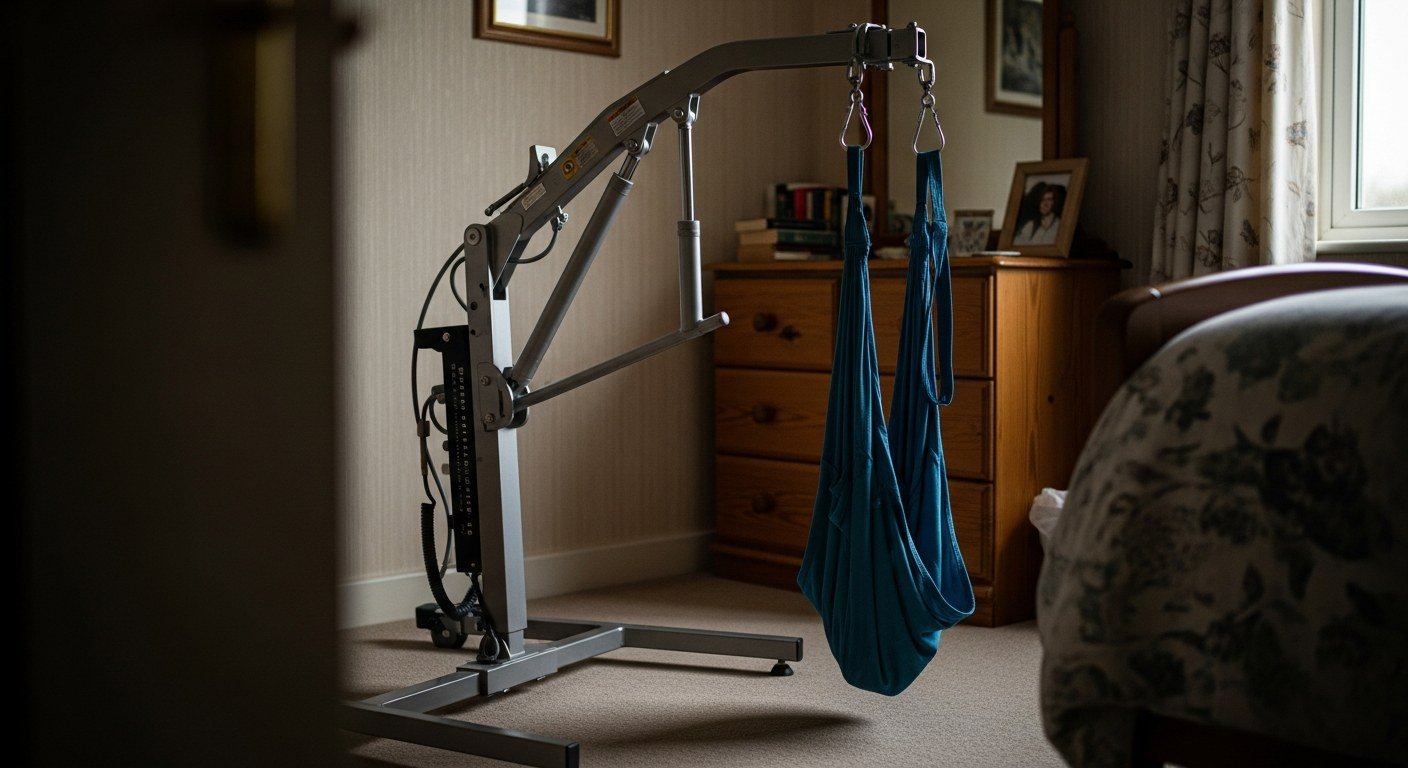
- Medicare Part B may cover 80% of the cost of a patient lift if it is prescribed by a physician as medically necessary Durable Medical Equipment (DME).
- The key to approval is documenting that the patient is non-ambulatory and requires 'maximal assistance' for all transfers, or is 'bed-confined.' Your doctor must include this specific language in their notes and prescription.
- As outlined by the Centers for Medicare & Medicaid Services (CMS), "Patient lifts are classified as covered Durable Medical Equipment (DME) when prescribed by a physician for a patient who is bed-confined or requires maximum assist for transfers." [3]
💡 What You Can Do Today: Write this sentence on a notepad for your next doctor's appointment: 'We need to document that [Patient's Name] is non-ambulatory and requires maximum assistance for all transfers to justify a prescription for a hydraulic patient lift.'
Are you risking your own health to care for your loved one?
Navigating the complexities of late-stage Parkinson's care is overwhelming, but you don't have to do it alone.
Request a Call
Which Transfer Method is Right for You?
| Method | Best For | Caregiver Strain | Patient Safety Risk |
|---|
| Manual Transfer (1 or 2 Person) | Patients who can reliably bear significant weight and assist the transfer. Not for patients with freezing or severe rigidity. | EXTREMELY HIGH - Risk of acute and chronic spinal injury. | HIGH - Risk of falls, skin tears, and shoulder dislocation. |
| Sit-to-Stand Lift | Patients who have good head/neck control and can bear some weight on their legs but cannot stand fully on their own. | LOW - The lift does the work, caregiver guides. | MODERATE - Requires patient cooperation; not for those with severe cognitive or physical deficits. |
| Full Body (Hoyer) Lift | Patients who are non-weight bearing, have severe rigidity, cognitive impairment, or are totally dependent for transfers. | VERY LOW - The lift does all the lifting, eliminating caregiver strain. | LOWEST - When used correctly, this is the safest method for both patient and caregiver. |
The Hidden Dangers of Manual Transfers
The most obvious risk of manual lifting is a catastrophic fall or a slipped disk in your own back. But for a person with Parkinson's, there's another hidden danger: shoulder injury. Pulling a person up from under their arms, often called the 'underarm hook,' can lead to glenohumeral subluxation—a partial dislocation of the shoulder joint. Parkinson's-related rigidity and muscle wasting can make the joint unstable, and the force of a manual transfer can easily injure the delicate rotator cuff. A Hoyer lift sling supports the entire body and trunk, eliminating this dangerous, focused pressure on the shoulder joints. (Source: American Physical Therapy Association, Current Guidelines)
MIDNIGHT CAREGIVER ACTION: Stop lifting them under the arms immediately. Contact your neurologist tomorrow and formally request a Durable Medical Equipment (DME) prescription for a 'Hydraulic Patient Lift with a U-Sling.' Medicare Part B may cover 80% of the cost (rules and coverage vary by state and individual plan — consult a licensed professional or SHIP counselor for your specific situation).
Getting Your Hoyer Lift: A Practical Checklist
When you speak with the neurologist, be precise. Do not just say 'lifting is hard.' Use the specific language that insurance providers look for. Explain that the patient requires 'maximal assistance from one to two people for all transfers.' Detail the number of unsafe transfers or near-falls that have occurred. Request a physician's order for a 'Hydraulic Patient Lift and a U-Sling' and also ask for a referral for an 'in-home PT/OT evaluation for safe patient handling equipment.' The therapist's official report provides powerful, independent justification for medical necessity, making Medicare approval much more likely. (Source: Family Caregiver Alliance, Current Guidelines)
✅ Your Next Steps
Use this checklist to start today.
- ✅ Add to Prep PDF: Submit Medicare DME prescription request for a Hydraulic Patient Lift and U-Sling.
- ✅ Document Transfer Failures: Keep a simple log of every time a transfer was unsafe or required more than one person's maximum effort. Note the date, time, and situation.
- ✅ Schedule a PT/OT Evaluation: Ask the neurologist for a referral to a Physical or Occupational Therapist who can perform an in-home safety and equipment evaluation.
- ✅ Contact Your Local SHIP: Find your State Health Insurance Assistance Program (SHIP) counselor to get free, unbiased advice on your specific Medicare DME coverage (rules and coverage vary by state and individual plan).
- ✅ Join the Community: Attend a free Parkinsons.Community peer support session to connect with other caregivers who have navigated this process.
Clinical References
- Aamodt WW, Kluger BM, et al. Caregiver Burden in Parkinson Disease: A Scoping Review of the Literature from 2017-2022. J Geriatr Psychiatry Neurol. 2024;37(2):96-113. PMID: 37551798.
- Geerlings AD, Kapelle WM, et al. Caregiver burden in Parkinson's disease: a mixed-methods study. BMC Med. 2023;21(1):247. PMID: 37424022.
- Mosley PE, Moodie R, et al. Caregiver Burden in Parkinson Disease: A Critical Review of Recent Literature. J Geriatr Psychiatry Neurol. 2017;30(5):235-252. PMID: 28743212.
⚠️ Medical & Legal Disclaimer: This article is for educational purposes only and does not constitute medical advice. Consult a Movement Disorders Specialist for evaluation of Hoyer Lift Transfers. Parkinsons.Community provides educational navigation support only and does not perform clinical triage.
📞 When to Call 911: If you or your loved one experiences a medical emergency — difficulty breathing, loss of consciousness, a fall with injury, chest pain, or sudden severe confusion — call 911 immediately. The information on this page is educational and does not replace emergency medical services.
FREE MEMBER BENEFIT
You Don't Have to Face This Alone
Deciding to use a Hoyer lift is an emotional and logistical challenge. Connect with peers who understand the weight of this responsibility and can share their experience.
Join Parkinsons.Community
Educational support only. Never medical triage.