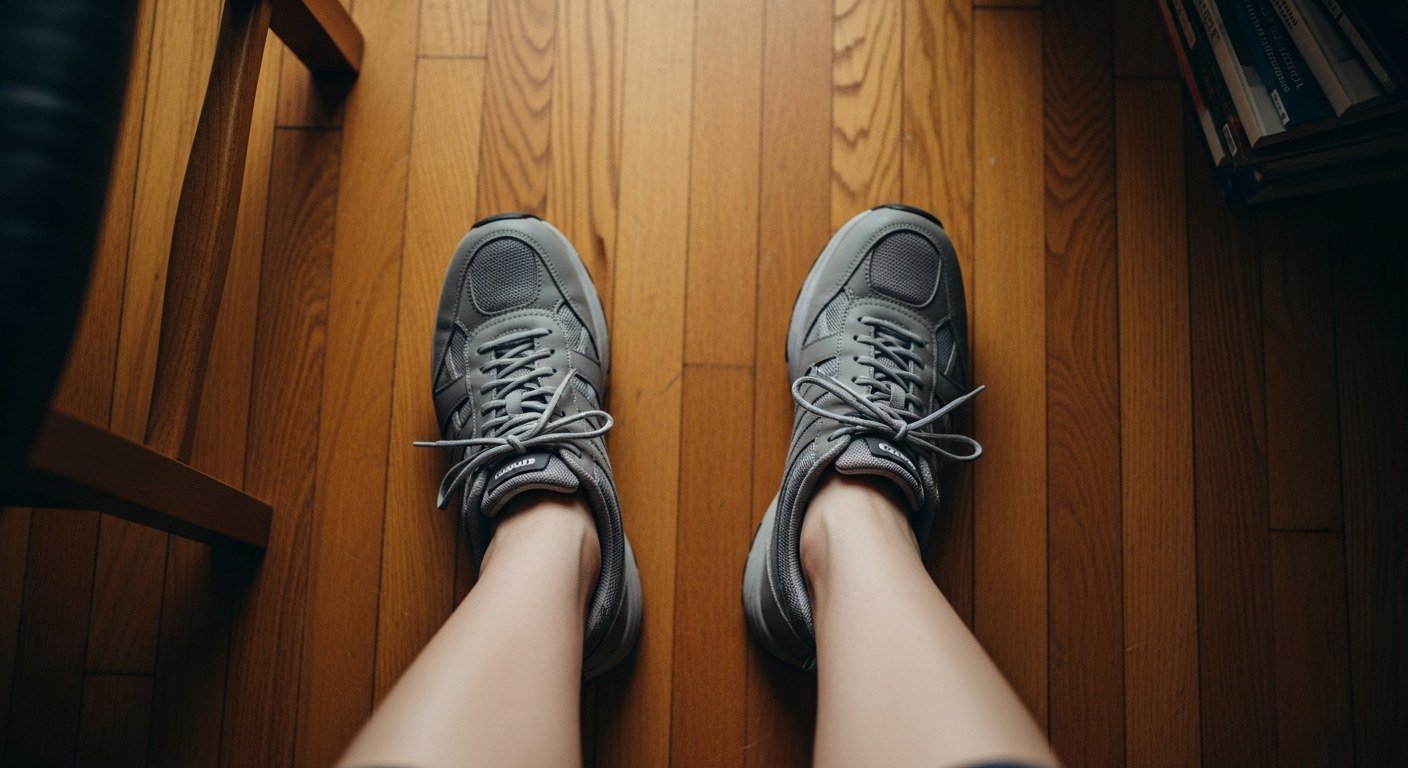
- The core biomechanical failure is the crossing of the feet, which is a direct result of the brain's inability to coordinate the multiple limbs involved in a turn. (Source: MDS, Current Guidelines)
- The Journal of Biomechanics confirms this: "Parkinson's impairs complex multi-limb coordination; pivoting sharply forces the feet to cross, geometrically destroying the patient's base of support."
- This foot-crossing, sometimes called 'scissoring,' creates a moment of complete instability. Every safe turning strategy, including the Clock Face Method, is designed specifically to prevent the feet from ever crossing the body's midline. (Source: NINDS, Current Guidelines)
💡 What You Can Do Today: Place a brightly colored piece of tape on the floor in a high-traffic area like the kitchen. Use this as a visual cue. Practice turning *around* the tape in a wide 'U' shape, consciously keeping your feet from ever touching or crossing the line. This builds new, safer muscle memory.
Is turning around causing dangerous falls?
You don't have to navigate these daily risks alone.
Request a Call
Which Turning Strategy Is Right for You?
| Approach | Best For | Time to Start | Cost |
|---|
| The 'Clock Face' Method | PwP and caregivers needing an immediate, no-cost technique for daily use. | Immediately | Free |
| Formal Physical Therapy | Individuals with frequent falls, freezing of gait, or difficulty mastering the Clock Face Method. | 1-3 weeks for referral | Co-pay (rules and coverage vary by state and individual plan) |
| LSVT BIG Program | PwP seeking a comprehensive, whole-body retraining program for larger, safer movements. | 2-4 weeks to find provider | Varies (rules and coverage vary by state and individual plan) |
The Hidden Danger: How 'Off' Periods Amplify Turning Risk
Motor fluctuations dramatically increase the risk of pivot falls. During an 'off' period, when medication effects wane, the basal ganglia's ability to run the 'automatic pilot' for turning can fail completely. This isn't just a matter of increased stiffness; it's a shutdown of the sequencing program required for a multi-step movement. A turn is a 'sequence effect' task; the first step may work, but the brain fails to cue the second or third, causing a freeze or foot tangle. In these moments, relying on a conscious, deliberate strategy like the Clock Face Method is not just helpful—it's essential for preventing a fall. (Source: MJFF, Current Guidelines).
During 'off' periods, the brain's automatic turning sequence fails. The Clock Face Method provides a manual override.
How to Talk to Your Doctor About Pivot Falls
To get the right help, use specific language with your doctor or physical therapist. Instead of saying, 'I fall when I turn,' describe the mechanism. For example: 'I am experiencing pivot-induced gait disruption. My feet cross over each other if I try to turn too quickly.' Or, 'When I try to turn in the kitchen, my feet feel glued to the floor, and I lose my balance.' This specific terminology helps the clinician understand the precise biomechanical failure, justifying a physical therapy referral focused on turning mechanics and compensatory strategies. Discussing these specific symptoms with your Movement Disorders Specialist is critical for a coordinated care plan. (Source: APTA, Current Guidelines).
✅ Your Next Steps
Use this checklist to start today.
- ✅ Practice the Clock Face: Dedicate 5 minutes today to practicing the method in a safe, open space without distractions.
- ✅ Establish a 'No-Talk Zone': Agree with family members to pause conversation when a turn is in progress to allow for full concentration.
- ✅ Use Visual Cues: Place a small, brightly colored mat in high-traffic turning spots (e.g., kitchen, bathroom) as a reminder to use a U-turn.
- ✅ Add to Prep PDF: Request a Physical Therapy referral specifically for turning and pivot mechanics at your next neurology appointment.
- ✅ Join the Community: Attend a free Parkinsons.Community peer support session to share strategies with others who understand.
Clinical References
- Pillai L, Shah K, et al. Increased foot strike variability during turning in Parkinson's disease patients with freezing of gait. Gait Posture. 2022;92:321-327. PMID: 34915403.
- Park H, Shin S, et al. Classification of Parkinson's disease with freezing of gait based on 360° turning analysis using 36 kinematic features. J Neuroeng Rehabil. 2021;18(1):177. PMID: 34930373.
- Rahimpour S, Gaztanaga W, et al. Freezing of Gait in Parkinson's Disease: Invasive and Noninvasive Neuromodulation. Neuromodulation. 2021;24(5):829-842. PMID: 33368872.
⚠️ Medical & Legal Disclaimer: This article is for educational purposes only and does not constitute medical advice. Consult a Movement Disorders Specialist for evaluation of Pivot falls from basal ganglia failure to coordinate multi-limb turning. Parkinsons.Community provides educational navigation support only and does not perform clinical triage.
📞 When to Call 911: If you or your loved one experiences a medical emergency — difficulty breathing, loss of consciousness, a fall with injury, chest pain, or sudden severe confusion — call 911 immediately. The information on this page is educational and does not replace emergency medical services.
FREE MEMBER BENEFIT
Turning Safely Is a Skill — and It Can Be Learned
The constant fear of a fall can lead to hesitation and isolation. Learning and practicing safe turning techniques with the support of peers can restore confidence and help maintain independence.
Join Parkinsons.Community
Educational support only. Never medical triage.