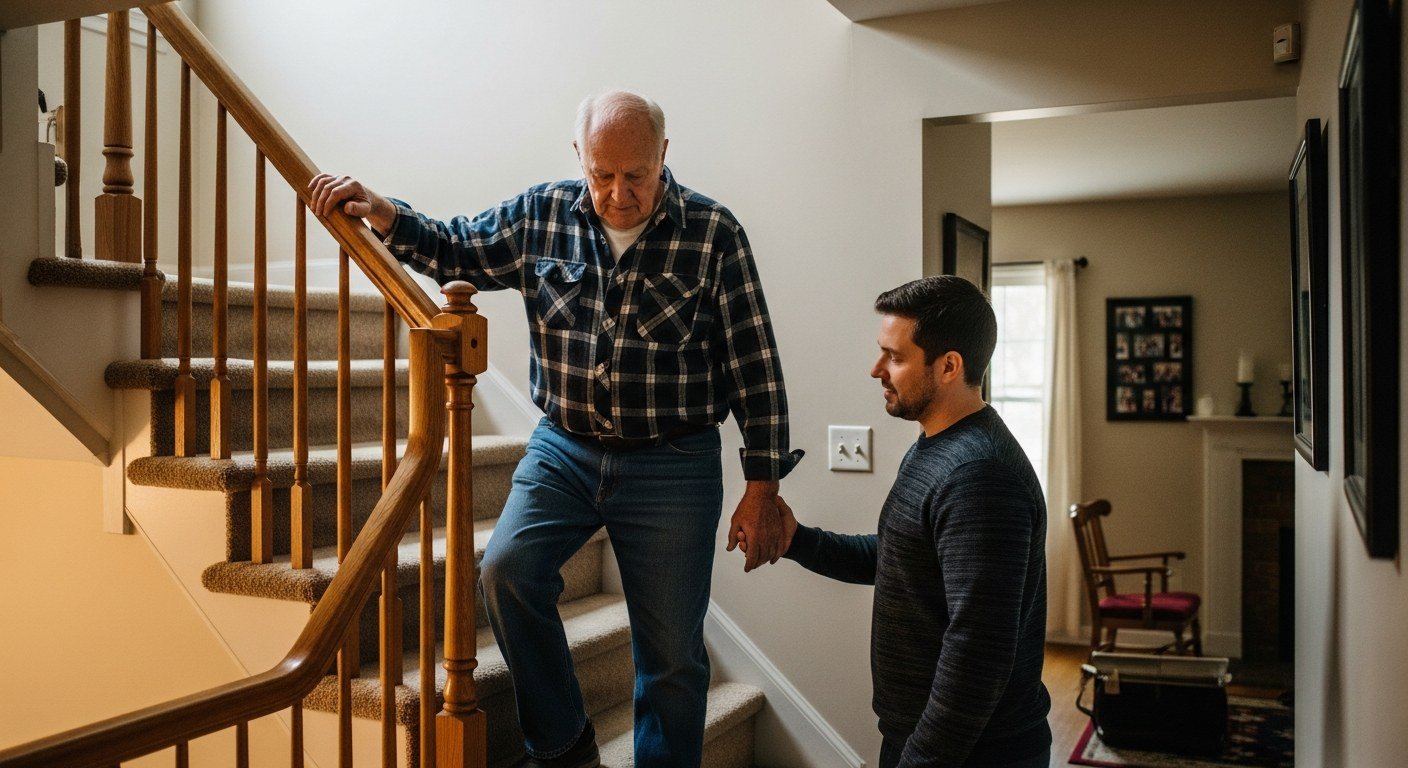
- Ensure handrails are securely mounted on both sides of the staircase and are at a proper height (typically 34-38 inches above the steps). (Source: Parkinson's Foundation, Current Guidelines)
- Improve lighting dramatically. Use bright, non-glare bulbs and consider motion-activated night lights or light strips along the baseboards.
- Remove all clutter. Stairs must be completely clear of shoes, books, or decorative items. Consider adding high-contrast, non-slip treads to each step to improve visibility and traction. (Source: APDA, Current Guidelines)
💡 What You Can Do Today: What You Can Do Today: Choose one staircase in your home and completely clear it of any and all objects. Wipe down the handrail. If lighting is poor, place a bright lamp at the top and bottom as a temporary measure until a permanent solution can be installed.
Has stair descending become the most terrifying part of your loved one's day?
You don't have to navigate these difficult safety decisions alone.
Request a Call
Which Approach Is Right for You?
| Approach | Best For | Time to Start | Cost |
|---|
| PT-Guided Training | Individuals with early to moderate balance issues who can still safely practice new motor skills. | 1-3 weeks (after physician referral and PT evaluation). | Typically covered by insurance after deductible/copay. |
| Home Modifications | Nearly all patients. Essential for reducing environmental risk factors like poor lighting or lack of handrails. | Immediate (for clutter removal) to 1 week (for installations). | $ (lighting) to $$ (handrail installation). |
| Stairlift Installation | Individuals with severe postural instability, frequent freezing, or when PT-guided techniques are no longer safe. | 2-6 weeks (for consultation, measurement, and installation). | $$$$ (often not covered by insurance). |
The Hidden Risk: Why 'Looking Down' Makes Festination Worse
The natural instinct when you're afraid of falling on stairs is to look down at your feet. However, in Parkinson's, this can be counterproductive. Dropping your head to look down shifts your center of gravity even further forward, which can trigger or worsen festination. Neurologic physical therapists often coach a 'chin up, eyes forward' posture, encouraging you to look at a spot on the wall or the landing ahead. This helps keep your posture more upright and your center of mass stable. It feels unnatural at first, but it is a key component of breaking the forward-momentum cycle. (Source: APTA, Current Guidelines)
Your instinct to look at your feet may actually be increasing your fall risk.
When Stairs Are No Longer Safe: Next Steps
There may come a point where, even with techniques and modifications, stairs pose an unacceptable risk of a catastrophic fall. This is a difficult but critical conversation to have with your family and medical team. A formal physical and occupational therapy evaluation is mandatory to make this determination. If postural instability is severe, the clinical recommendation may be to discontinue independent stair use and consider installing a stairlift or rearranging the home for single-level living. This is not a failure; it is a proactive safety measure to preserve health and prevent a life-altering injury. (Source: Parkinson's Foundation, Current Guidelines)
✅ Your Next Steps
Use this checklist to start today.
- ✅ Request a PT Evaluation: Ask your Movement Disorders Specialist for a prescription to a physical therapist specializing in neurologic conditions. Use this exact phrase: 'I need a stair safety and descending technique assessment.'
- ✅ Assess Your Home: Use the checklist in this article to evaluate your staircase lighting, handrails, and clutter today.
- ✅ Discuss With Family: Talk openly about the fear and the risks. Use the comparison table to begin a conversation about long-term solutions, including the financial and emotional aspects of installing a stairlift.
- ✅ Practice on a Single Step: Safely practice the 90-degree turn on a curb or single step with supervision. Do not use a full staircase until you have been evaluated by a PT.
- ✅ Join the Community: Attend a free Parkinsons.Community peer support session to share strategies with others who are facing the exact same challenge.
Clinical References
- da Conceição NR, Teixeira-Arroyo C, et al. Influence of Parkinson's Disease on Judging Stair Step Height: Exploratory Study. Percept Mot Skills. 2019;126(1):106-118. PMID: 30501375.
- Jones SV, Waltz C, et al. Characterizing Stair Ambulation Kinetics and the Effects of Dual Tasking in Parkinson's Disease. J Clin Med. 2025. PMID: 40869655.
- Roth N, Ullrich M, et al. Real-World Stair Ambulation Characteristics Differ Between Prospective Fallers and Non-Fallers in Parkinson's Disease. IEEE J Biomed Health Inform. 2022;26(9):4733-4742. PMID: 35759602.
⚠️ Medical & Legal Disclaimer: This article is for educational purposes only and does not constitute medical advice. Consult a Movement Disorders Specialist for evaluation of Stair Descending Failure (Festination and Forward Momentum Crisis). Parkinsons.Community provides educational navigation support only and does not perform clinical triage.
🚨 When to Call 911: If your loved one experiences a fall with head injury, loss of consciousness, difficulty breathing, chest pain, severe confusion, or any life-threatening symptom — call 911 immediately. Do not wait. This information is educational and does not replace emergency services.
FREE MEMBER BENEFIT
Fear of Stairs Doesn't Have to Mean Loss of Independence
Losing safe access to parts of your home is a profound challenge. Our community offers a space to discuss these tough decisions, from PT strategies to the logistics of home modifications.
Join Parkinsons.Community
Educational support only. Never medical triage.