Blood Pressure
Feeling Dizzy When You Stand? The Dangers of nOH in Parkinson’s
Updated
Need to know
What is nOH? Understanding Your Body’s “Autopilot”
Quick answer
That sudden head rush or feeling like the room is spinning when you stand up is more than just a momentary discomfort—it’s a critical symptom called neurogenic orthostatic hypotension (nOH), and it requires a proactive plan.
Feeling Dizzy When You Stand? The Dangers of nOH in Parkinson's
That sudden head rush or feeling like the room is spinning when you stand up is more than just a momentary discomfort—it's a critical symptom called neurogenic orthostatic hypotension (nOH), and it requires a proactive plan.
⚡ Quick Answer
Parkinson's damages the autonomic nervous system, impairing the body's ability to release norepinephrine. This chemical messenger normally constricts blood vessels to maintain blood pressure when standing. Without it, blood pools in the legs, causing a sharp drop in blood pressure to the brain, resulting in dizziness.
In This Article:
- What is nOH? Understanding Your Body's "Autopilot"
- 3 Immediate Strategies to Manage Dizziness Today
- How nOH Differs From Common Fainting
- The Critical Connection Between nOH and Parkinson's Medications
- How to Track Your Symptoms for a Productive Neurology Visit
What Is Neurogenic Orthostatic Hypotension (nOH)?
Think of your autonomic nervous system as your body’s autopilot. It manages blood pressure, heart rate, and digestion without you having to think about it. When you stand up, this system instantly tells your blood vessels to tighten, pushing blood up to your brain. Parkinson's disease can damage these autonomic nerves. As a result, the "tighten vessels" signal doesn't get sent properly. Blood pressure plummets, starving the brain of oxygen for a moment and causing that terrifying dizziness, lightheadedness, or even fainting. This isn't just "getting up too fast"—it's a neurological signal failure. (Source: NINDS, Current Guidelines)
~30-40%
of people with Parkinson's disease develop symptomatic nOH, making it a common but often under-addressed complication. (Source: MDS, Current Guidelines)
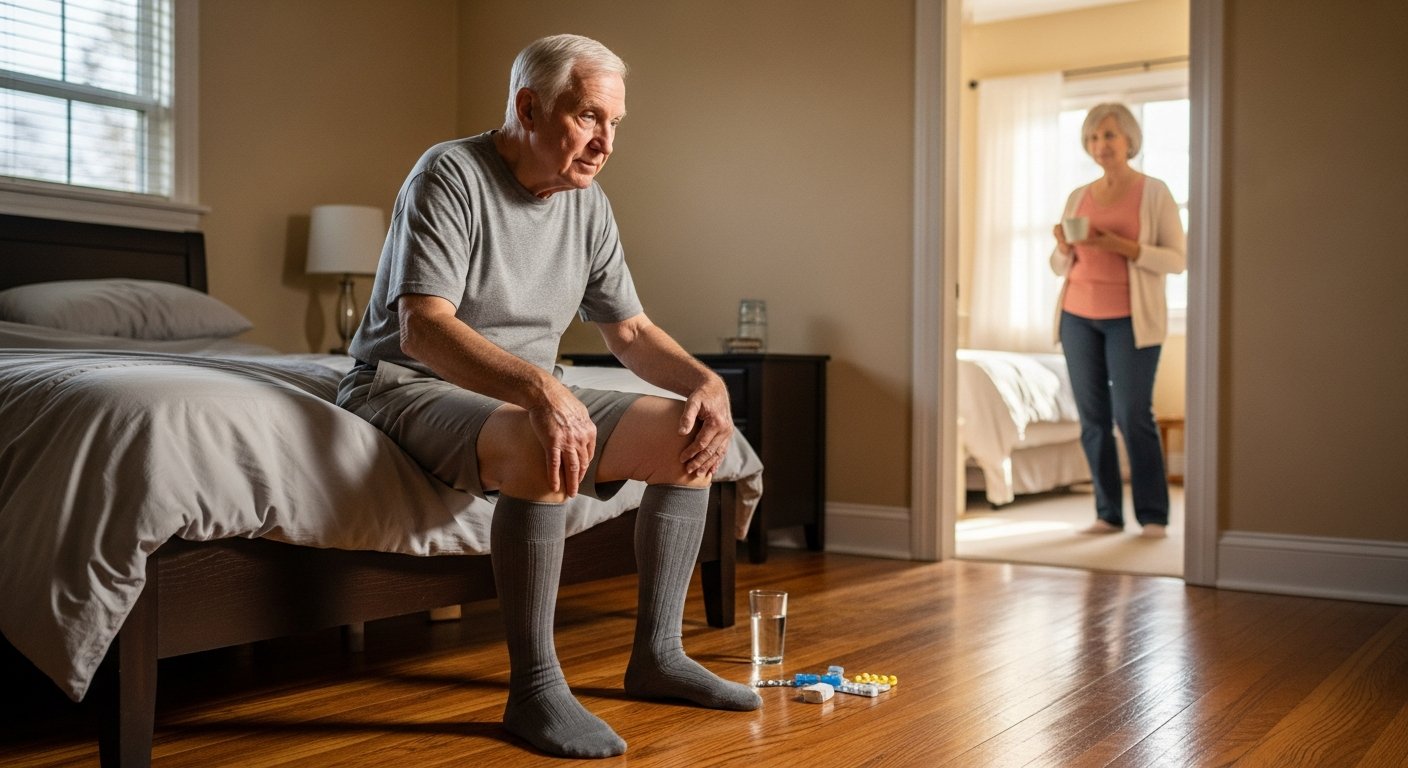
"Every morning is the same negotiation. Before his feet even touch the floor, I watch him pause. He'll sit at the edge of the bed for a minute, then slowly push himself up, one hand already reaching for the bedpost. I hold my breath, waiting to see if the world stays upright for him today. Sometimes it does. Sometimes I see that flicker in his eyes and I know the room is spinning."
3 Management Strategies You Can Use Immediately
Managing nOH often starts with simple, consistent lifestyle adjustments. Here are three physical and behavioral strategies you can implement today to reduce dizziness and improve safety.
Strategy 1: Use Postural Countermeasures
Before you change position—especially from lying down to sitting or sitting to standing—you can "pre-activate" your circulatory system. These simple muscle contractions help squeeze blood out of your legs and back up toward your heart and brain, buffering against the pressure drop. (Source: AAN, Current Guidelines)
Common maneuvers include:
- Ankle Pumps: While seated, rapidly flex and point your feet for 30 seconds.
- Leg Crossing: While standing, cross one leg over the other and tense your thigh and gluteal muscles.
- Isometric Contractions: Tense your leg, abdominal, and buttock muscles for 15-20 seconds before rising.
💪 What You Can Do Today: The next time you are about to stand up from a chair, remain seated and do 30 seconds of ankle pumps. Then, rise slowly. Notice if the transition feels more stable.
Strategy 2: Modify Your Environment for Safety
Because the primary danger of nOH is a fall, creating a safer environment is a powerful, proactive step. The goal is to reduce the distance you could fall and ensure there are stable objects to grab onto if dizziness strikes. A simple audit of your daily path can reveal hidden risks.
💪 What You Can Do Today: Walk the path from your bed to the bathroom. Remove one potential trip hazard—like a throw rug, a stray cord, or a piece of furniture that narrows the walkway. This simple act creates a clearer, safer "recovery zone."
Strategy 3: Implement a Timing Protocol
What and when you eat, drink, and take medication can significantly impact orthostatic hypotension. Dehydration lowers blood volume, making nOH worse. Large, carbohydrate-heavy meals can divert blood to the digestive system, pulling it away from the brain. Parkinson's medications themselves can also lower blood pressure. (Source: MDS, Current Guidelines)
💪 What You Can Do Today: Before bed tonight, place a 16-ounce (500 mL) glass of cool water on your nightstand. Drink the entire glass before you even sit up in the morning. This "water bolus" can help temporarily raise blood pressure for the critical transition from lying to standing.
Coordinating hydration, meal size, and medication schedules is a key conversation to have with your neurologist. Never adjust medication without direct guidance from your prescribing physician or Movement Disorders Specialist.
Is dizziness when standing keeping you from getting to doctor appointments safely?
You don't have to figure this out alone. A Care Navigator can help you prepare questions and strategies for your next neurology visit.
Get Pre-Visit SupportWhy Dizziness When Standing Is Different from Fainting
While both can lead to loss of consciousness, nOH and common fainting (vasovagal syncope) have different causes. Vasovagal syncope is often triggered by an emotional stressor, pain, or the sight of blood, causing a sudden drop in both heart rate and blood pressure. nOH is a purely mechanical problem: the trigger is the physical act of standing up, and the cause is the autonomic nervous system's failure to compensate for gravity. (Source: AHA, Current Guidelines). Understanding this distinction is key, as the management strategies are completely different.
The Medication Connection
It's a challenging balancing act. The very medications that help manage Parkinson's motor symptoms, like levodopa and dopamine agonists, can also relax blood vessels and worsen nOH. Additionally, many people with Parkinson's are also on medication for high blood pressure (antihypertensives). This can create a dangerous conflict, where medication taken to lower blood pressure makes the postural drop even more severe. It's crucial that your Movement Disorders Specialist and your primary care doctor or cardiologist are communicating about all your medications. Never adjust medication without direct guidance from your prescribing physician or Movement Disorders Specialist.
How to Track nOH for Your Doctor Visit
To help your doctor understand the severity and patterns of your nOH, a simple log is invaluable. Vague reports of "dizziness" are hard to act on, but specific data is gold. Your log should include:
- Date & Time: When did the episode occur?
- Trigger: What were you doing right before? (e.g., "Stood up from breakfast," "Got out of bed").
- Symptoms: Be specific. (e.g., "lightheaded," "room spun," "blurred vision," "felt faint").
- Blood Pressure (Optional): If you have a home monitor, take readings while sitting and then again 1-3 minutes after standing. A drop of 20 mmHg systolic or 10 mmHg diastolic is a clinical sign of OH. (Source: AAN, Current Guidelines)
Bringing this log to your appointment transforms the conversation from "I feel dizzy sometimes" to "I have a 30-point systolic drop every morning after taking my medication." This gives your doctor the precise information needed to help.
Your nOH Next Steps Checklist
- Start a hydration and symptom log today. Data is your most powerful tool.
- Perform the "bed-to-bathroom" safety audit and remove one fall risk.
- Ask your doctor to perform a "standing blood pressure check" at your next visit.
- Compile a complete list of ALL medications (for PD and non-PD issues) to review with your neurologist.
- Inquire if a formal "tilt-table test" might be appropriate to confirm the diagnosis of nOH.
⚠️ Medical & Legal Disclaimer: This article is for educational purposes only and does not constitute medical advice. Consult a Movement Disorders Specialist for clinical evaluation of autonomic symptoms. Parkinsons.Community provides educational navigation support only and does not perform clinical triage.
You Deserve to Get There Safely.
Feeling anxious about falls or dizziness before a doctor visit is a real barrier to care. A Care Navigator can help you organize your symptoms and questions, so you feel confident and safe. Prepare for your next neurology visit with free, 1-on-1 support.
Speak with a Care NavigatorEducational support only. Never medical triage.
Clinical References
- Gibbons CH, Schmidt P, et al. The recommendations of a consensus panel for the screening, diagnosis, and treatment of neurogenic orthostatic hypotension and associated supine hypertension. J Neurol. 2017;264(8):1567-1582. PMID: 28050656.
- Idiaquez JF, Idiaquez J, et al. Neurogenic Orthostatic Hypotension. Lessons From Synucleinopathies. Am J Hypertens. 2021;34(2):125-133. PMID: 33705537.
- Cutsforth-Gregory JK, Low PA. Neurogenic Orthostatic Hypotension in Parkinson Disease: A Primer. Neurol Ther. 2019;8(2):307-324. PMID: 31456212.
Clinical references
Medical & legal disclaimer. This protocol is general educational information. It is not medical advice and does not replace your care team. Always consult your neurologist before changing medications or care. In an emergency, call 911.